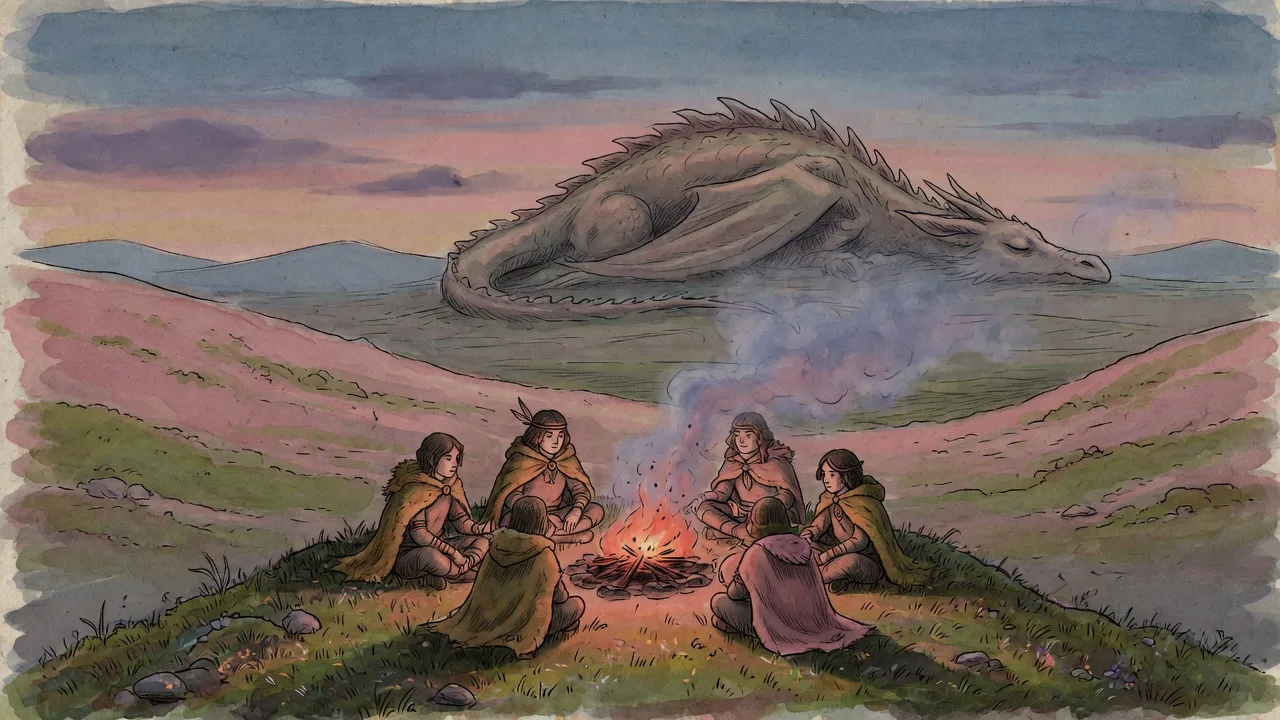
Four of A Sharp’s games put a myth on the page as a painted scene, then ask a small group what to do next. King of Dragon Pass, Six Ages: Ride Like the Wind, Six Ages 2: Lights Going Out, and Thousand Hells: The Underworld Heists share that structure. The pictures stay hand-painted. What changes is whose myth the scene belongs to, and how close the gods still are.
King of Dragon Pass
King of Dragon Pass is the game that sets the shape. You lead an Orlanthi clan in Glorantha. The clan left Heortland after Belintar, the Pharaoh, took the throne, and it resettles Dragon Pass, empty since the Dragonkill War. A ring of seven leads the clan. The year has five seasons. In each season you make two large decisions, and hundreds of illustrated scenes cut in. The stated goal is a kingdom. That takes seven heroquests, a town built with other clans, and a marriage that makes peace with the Horse-Spawn. The chieftain then becomes king.
The 1999 game has no animation. Dunham said the artists worked in watercolor, ink, acrylic, airbrush, and scratchboard, so the scenes would look like a magical Bronze Age. Stefano Gaudiano, Mike Raabe, and Damon Brown were the principal artists. On 21 March 2000 the Independent Games Festival gave the game Best Visual Art. A Sharp’s page for the game is still up. Shipping for Windows and Macintosh began on 29 October 1999.
Six Ages: Ride Like the Wind
Six Ages: Ride Like the Wind keeps the scenes and the seasons, and moves them to a time when gods still walked among people. It is set thousands of years earlier in Glorantha. You lead a clan of Riders. King of Dragon Pass puts you in charge of Orlanthi. The store description lists more than 400 interactive scenes, hand-painted illustrations, and about four times as much land. Dunham and Laws led the work. It took about four years. A Sharp released it on iOS on 28 June 2018. Kitfox Games published the Windows and Mac versions on 17 October 2019.
Six Ages 2: Lights Going Out
Six Ages 2: Lights Going Out is ten generations later, and the myth has come apart. Kitfox’s launch note opens with “life after myths.” Some of the gods are already dead. The clan is trying to last while the forces of Chaos assault the world. The same note says more than 600 interactive scenes. The simulation picks which scenes appear and how they come out. A saga writes down what the clan did. Advisors remember promises, and they also judge you. The council is drawn again each time you play.
The game stands on its own. A save from Six Ages: Ride Like the Wind can carry some choices into it, or you can start a new clan. Kitfox Games published it on 21 August 2023 for Windows, Mac, and iOS. The current series site leads with this game.
Thousand Hells: The Underworld Heists
Thousand Hells: The Underworld Heists keeps the painted scene and leaves Glorantha. Four heroes accept a contract and go down into an underworld. The contract changes between runs, and so does the underworld they enter. Kitfox’s July 2026 note lists more than 280 narrative encounters, hand-painted illustrations, and an anthology by eight writers. The pictures are still hand-painted. A Sharp and Kitfox Games released it on 8 September 2026 for PC and Mac. The Steam page is the current listing.
The four games share one way of playing. An illustrated scene arrives. A council, or a party of four, chooses. A simulation decides what that choice does to the next scene. In King of Dragon Pass and Six Ages: Ride Like the Wind the myth is still alive around the clan. In Six Ages 2: Lights Going Out the gods are dying, and the saga is what the clan has left. In Thousand Hells: The Underworld Heists the myth is the contract, and the world is a different one. The paint is the part that stays.