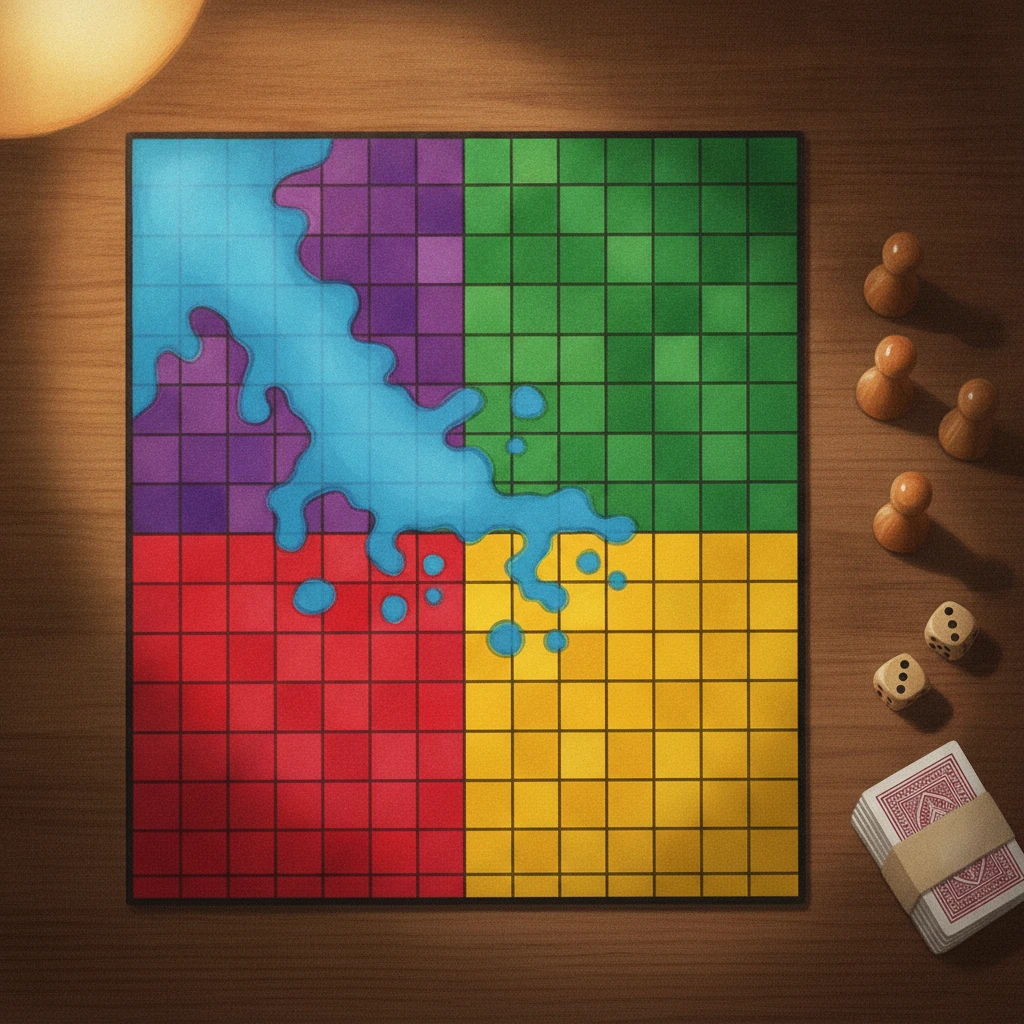
On 3 November 2026 I asked an AI coding agent to play that day’s Daily Puzzle of Flood, a flood-it colour puzzle. The board is 14 by 14 with six colours, the move limit is 29, and the best public score that day was 29. The agent didn’t start by playing. It read the game’s JavaScript and saw that the daily board is built in the browser from a seed the server hands out, so it rebuilt the same board, all 196 cells. It grouped the cells into 155 same-colour regions and ran a search that can prove when nothing shorter exists. The answer was 23 moves, found in 56 milliseconds after 26,880 positions. A second, separate program agreed.
Played in the game’s practice mode, which sends no score, the screen said “Perfect! 23 moves (limit 29)”. Nothing went to the leaderboard. It took the agent about 20 minutes and me none.
Flood is a good little game, and this is no complaint about it. It shows the general problem: a puzzle with full information, fixed rules and one shared daily board is a closed problem. Once someone solves it, the daily ritual turns into a lookup. The more interesting question is which games don’t close like that, and why. Short answer: games with hidden information, other people, heavy randomness, hard execution or no single goal.
Solving the fun out is older than AI
Players were doing this long before language models. Soren Johnson, lead designer of Civilization IV, put it in one line in his column “Water Finds a Crack” (Game Developer, March 2011): “Given the opportunity, players will optimize the fun out of a game.”
Build wikis and spreadsheets record the best gear and skill paths for RPGs. Speedrunners route games such as Super Mario Bros. down to single frames. Some classic games are solved outright: Jonathan Schaeffer’s team proved in 2007 that perfect checkers is a draw, and Connect Four was solved in 1988, by James Dow Allen and, separately, by Victor Allis. Chess isn’t solved, but engines play far above any human, and top players prepare their openings with them. AI only makes the old habit cheaper: the agent on Flood needed no community, no wiki and no weeks of play.
What makes a game solvable
A game is easy to solve when it has perfect information, deterministic rules, a small or fixed state space and one score to maximise. A shared daily puzzle adds the last ingredient: everyone gets the same board, so one solution serves everyone. Flood’s daily has all of it. The 196 cells group into 155 regions, and a good lower bound on the moves left prunes most of the search. The proven optimum, 23, is exactly the game’s own three-star mark of six under the limit. Sudoku is the same kind of object: a computer solves any grid instantly, and the only reason to play is that you choose to do it yourself.
Games that resist being solved
Hidden information and bluffing come first, though poker shows the limits. Programs such as Libratus (heads-up no-limit, 2017) and Pluribus (six players, 2019) beat professionals, and serious players now study solver output. What survives is that the answer is a mixed strategy: you still have to randomise well, read opponents who deviate from it, and do it tired at the table.
Simultaneous decisions and mind games resist for a similar reason. In a football penalty kick, the kicker and the goalkeeper commit at the same moment, so the best plan is to mix your choices, the same logic as rock-paper-scissors. In Captain Sonar two crews act in real time and each guesses where the other submarine is; the right move depends on what the other side thinks you will do.
Other people as the content. In social deduction games such as Werewolf or The Resistance, the puzzle is the people at the table, and they change every game. There is nothing fixed to look up. My own party word game, impostor, works the same way: the other players are the puzzle, and they are different every time. My interactive novel Imprisoned, published on Choice of Games, has no score to maximise at all; the point is the story and the choices you make in it.
High-variance procedural generation. In a roguelike such as Dead Cells or Spelunky every run is different, so “optimal” becomes a policy, a way of deciding, instead of a sequence of moves. You can learn the policy from a wiki; you still have to apply it to a run nobody has seen.
Execution as the bottleneck. In rhythm games, fighting games and platformers, knowing the best line is the easy part. Landing it with your hands is the game.
No single objective. Sandboxes such as Minecraft or Garry’s Mod give you nothing to maximise, so there is nothing to solve.
Cooperation and story. In Keep Talking and Nobody Explodes the fun is two people describing wires to each other under a timer. In a narrative game the point is what happens on the way.
Games that change under you. League of Legends is rebalanced in regular patches, and games with player-made content keep adding new problems. A solution has a shelf life.
Resistant often means not worth solving
Most of that list resists in a weaker sense than it sounds. Either the game is not worth anyone’s time to solve, or its solution is a policy you still have to execute. Neither one is a wall.
AI keeps moving the line. Go was the classic example of a game too big for computers until AlphaGo beat Lee Sedol 4-1 in March 2016, and poker followed with Libratus in 2017 and Pluribus in 2019. People still play both, and play them hard. Stronger engines changed what studying the game looks like, and the reason to sit down stayed.
What this means for small web games
If you build small browser games, a few choices make solving harder or less rewarding. Give each player their own seed, so one published solution doesn’t fit everyone. Keep the daily board on the server until the player starts, and check submitted moves there, so reading the client code doesn’t give the board away. Score style, speed or risk as well as move count, so there is more than one number to chase. Add asymmetric or social mechanics, where the other player is the variable. And keep adding content, so any solution has a short life. None of these makes a game unsolvable. They make solving cost more than playing.
A daily puzzle like Flood is still worth playing. The board remains unchanged and still offers fresh challenges to solve. You can look the answer up, but doing so only detracts from the enjoyment if you choose to allow it. The fun is choosing not to.